Posts

Showing posts with the label Benedict XVI

For the Feast of the Holy Family (Cycle B, 2020)

Image
Jesus went down with them and came to Nazareth, and was obedient to them; and his mother kept all these things in her heart. And Jesus advanced in wisdom and age and favor before God and man.   —Luke 2:51-52 Christmas is a time for family. Whether we are spending the holidays with our biological families, religious communities and parish families, or “chosen” families of friends, Christmas is a season when we come together with those whom we love to celebrate love, especially God’s love enfleshed in the gift of his Son. This truth of Christmas was brought into sharp focus this year, as the realities of the coronavirus pandemic kept us from being with our families and those we love.  Contemporary icon of the Holy Family  by Marko Ivan Rupnik, SJ (2012) The Feast of the Holy Family, celebrated on the Sunday within the Octave of Christmas, is an invitation to reflect on the lives and relationships of the Holy Family of Jesus, Mary, and Joseph, and on how God’s grace is at wo...

For the 32nd Sunday in Ordinary Time (Cycle A, 2020)

Image
  Stay awake and be ready! For you do not know on what day your Lord will come. —Entrance Antiphon for the 32 nd Sunday in Ordinary Time, based on Matthew 24:42a, 44   Like many early Christians, including Saint Paul and the people of Thessaloniki , the Evangelist Matthew and his community would probably have struggled to reconcile their hope for the return of Jesus with their disappointment that it hadn’t happened yet. For most of us, the eschaton —the Second Coming of Christ and the Final Judgment—is an uncomfortable topic that might even smack of religious fanaticism. After all, how often have we dismissed religious leaders and self-proclaimed “prophets” who have declared that Jesus will return at a specific time and place? And yet, each Sunday, as we profess in the Nicene Creed, we declare our belief that “he will come again in glory to judge the living and the dead.” The Catechism of the Catholic Church develops this fundamental Christian doctrine when it s...

Knowing the Good Shepherd

Image
Jesus said: “My sheep hear my voice; I know them, and they follow me. I give them eternal life, and they shall never perish.” —John 10:27-28                                                           In his message for the 50 th World Day of Prayer for Vocations (which is celebrated each year on the Fourth Sunday of Easter) Pope Benedict XVI observed, “ Hope is the expectation of something positive in the future, yet at the same time it must sustain our present existence, which is often marked by dissatisfaction and failures… To have hope, therefore, is the equivalent of trusting in God who is faithful, who keeps the promises of the covenant.” This sense of hope is at the heart of this Sund...

A Mother's Love: A Reflection for New Year's Day

Image
The shepherds went in haste to Bethlehem and found Mary and Joseph, and the infant lying in the manger. When they saw this, they made known the message that had been told them about this child. All who heard it were amazed by what had been told them by the shepherds. And Mary kept all these things, reflecting on them in her heart. —Luke 2:16-19 To honor Mary as the Theotokos , the Mother of God, is to celebrate the unique role that she has played (and continues to play) in God’s plan of salvation. Today, the Solemnity of Mary, Mother of God, and the Octave Day of Christmas, we also recall the circumcision and naming of Jesus on the eighth day after his birth (cf. Luke 2:21). In a special way, on New Year’s Day, the Church invites us to pray for peace: “It is Our desire that, every year, this commemoration [of “The Day of Peace”] be repeated as a hope and as a promise… that Peace with its just and beneficent equilibrium may dominate the development of events to come” (Blessed ...

Saint Narcisa de Jesús: Watching for the Bridegroom

Image
Behold, the Bridegroom is coming; come out to meet Christ the Lord.    —Communion Antiphon for the Common of Virgins (based on Matthew 25:6) These Advent days are a time of joyful expectation, a time for watching and waiting. The Parable of the Ten Bridesmaids, the young women charged with waiting for the arrival of the bridegroom before for the wedding feast (see Matthew 25:1-13 ) is a fitting lesson for this holy season. Just like the women of the parable, we have a choice of preparing our lamps—our selves—to meet the Lord when he comes. We also, of course, have the option of living only in the moment, coasting along without paying attention to our responsibilities as disciples. On December 8, as we celebrate the Immaculate Conception of the Blessed Virgin, the Church also remembers Saint Narcisa de Jesús Martillo Morán, a woman who dedicated her life to watching for the Lord’s Coming just like the wise Bridesmaids in the parable. Born in Nobol, Ecuador, in 18...

Saint Silas and the "We" of the Church

Image
Paul chose Silas and departed after being commended by the brothers to the Lord. He traveled through Syria and Cilicia bringing strength to the churches. — Acts 15:40-41 I didn’t always have the name “Silas.” In fact, for the first 25 years of my life, I wasn’t even aware that there was a saint by the name of Silas. The only Silases I knew of were George Elliot’s Silas Marner and Dan Brown’s menacing monk in the DaVinci Code . However, as I was preparing to make my first vows as a Benedictine monk in 2004, I was faced with the challenge of discerning three names to present to the abbot, one of which he would choose to be my religious name. I had settled on my first choice, but was completely undecided about choices two and three. A week or so before I had to present my selections, I came across the website of an Anglican parish in London: Saint Silas the Martyr. I was struck by two things. First, I’d never heard of Saint Silas and, second, I really liked the name. And so I...

A few hours to go...

Image
In just a few hours, the Holy See will release Pope Francis' new encyclical on the environment, "Laudato Si." While encyclicals aren't infallible statements, th ... ey do represent one of the highest levels of teaching authority within the Church. As part of the Church's social teaching, we don't have the luxury of simply dismissing the document as one man's opinion. That Pope Francis has dedicated one to the care of creation represents his own resistance to consumerism, exploitation of the environment and the poor, and our "throw away culture." But, his call for greater accountability and environmental stewardship is continuing a trajectory begun by Bl. Pope Paul VI which was continued by St. John Paul II and Pope Benedict XVI.   I agree with many catechists and commentators that we should not read *about* the document, rather, we should take time to read the document. Unlike any other document issued by the Catholic Church in recent y...

Trinity Sunday: Hope Beyond Words

Image
Through the centuries, Christian Tradition has discerned four attributes that seem to capture what is essential to Who God is. Drawing on earlier Greek writers, Saint Thomas Aquinas identified three of these “Divine Attributes”: Truth, Beauty, and Goodness ; his contemporary, Saint Bonaventure , added unity to the list. More recently, Pope Benedict XVI reflected that: “There is no question of attempting to understand the meaning of it all, but simply the overflowing happiness of seeing the pure splendor of God’s truth and love. We want to let this joy reach out and touch us: truth exists, pure goodness exists, pure light exists. God is good” ( Homily for Midnight Mass , 2012).   The Holy Trinity by Nicoletto Semitecolo  On the one hand, the doctrine of the Trinity is rich and complex, a mystery that has all-too-often been distorted into a sort of metaphysical brainteaser that theologians and philosophers have tried to puzzle-out since the first generations after...

Saint Joan of Arc: A Lesson in Vocations

Image
Consider your own calling, brothers. Not many of you were wise by human standards, not many were powerful, not many were of noble birth. Rather, God chose the foolish of the world to shame the wise, and God chose the weak of the world to shame the strong. —1 Corinthians 1:26-27 In 1896, Mark Twain published his last completed novel. This unexpected work was also his favorite. It was entitled Personal Reflections of Joan of Arc, by the Sieur Louis de Conte . Twain later recalled, “I like Joan of Arc best of all my books; and it is the best.” Years before, in the 1850s, he had found a leaf from a biography of Joan of Arc, an event which began a lifelong fascination with her story. The book is a huge departure from Twain’s comedic writings, but it’s certainly worth reading. Mark Twain’s book is just one example of how a nineteen year old French girl, who lived an extraordinary (and extraordinarily unusual) life, and who died a horrific death, has held the imagination of so many fo...

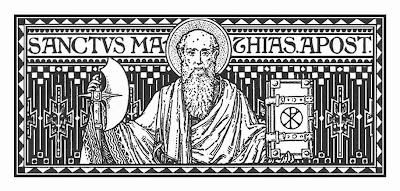
Saint Matthias: Authority and Service

Image
We should not seek from others the truth that we can easily receive from the Church. There, the Apostles, like one making a deposit, fully bestowed on her all that belongs to the truth. - Saint Irenaeus of Lyons   In the days between the Lord's Ascension and the descent of the Holy Spirit at Pentecost, Peter urged the followers of Jesus to select from among their number someone to take the place of Judas Iscariot as one of the Twelve. Inspired by the Psalmist, "Let another take his office" (Psalm 109:8), those present nominated two men: Joseph Barsabbas and Matthias. Under the inspiration of the Holy Spirit, Matthias was chosen (Acts 1:15-17, 20-26). According to tradition, Matthias preached the Gospel in Cappadocia and the area around the Caspian Sea. Honored as a martyr, his relics were brought from Jerusalem to Rome by Saint Helena . A vintage missal illustration for the Feast of Saint Matthias   In reflecting on the importance of the Apostles, Saint Aug...

Our Lady of Lourdes - Contemplating Mary's Smile

Image
It isn’t by chance that the Church celebrates World Day of the Sick on February 11 each year. Pope Saint John Paul II established this day of prayer and reflection in 1992 to encourage prayer for those who suffer from illness and for their caregivers. He himself had been diagnosed with Parkinson’s Disease only a year before and it is very likely that his own experience contributed to his decision to create this day of prayer. In his Message for this year’s World Day of the Sick, Pope Francis reflected: Wisdom of the heart means going forth from ourselves towards our brothers and sisters. Occasionally our world forgets the special value of time spent at the bedside of the sick, since we are in such a rush; caught up as we are in the frenzy of doing, of producing, we forget to give ourselves freely, taking care of others, being responsible for others… For this reason, I would like once again to stress “the absolute priority of ‘going forth from ourselves toward our brother...

The Epiphany: From Darkness to Light

Image
In his novel, Brideshead Revisited , Evelyn Waugh tells the story of Charles Ryder and the Marchmain family. Near the end of the novel, Ryder has an awakening, an epiphany , as he watches the final act of faith of a man he presumed shared his ambivalence toward Catholicism. Despite himself, Ryder “felt the longing for a sign…the hand moved slowly down his breast, then to his shoulder, and Lord Marchmain made the Sign of the Cross. Then I knew the sign I had asked for was not a little thing, not a passing nod of recognition, and a phrase came back to me from my childhood of the veil of the temple being rent from top to bottom.” In the ancient world, an epiphaneia was a visible manifestation of a god or the solemn visit of a secular ruler to the cities of his realm. Today’s celebration of the Epiphany of the Lord brings together the quiet realizations of a Charles Ryder with the grandeur of a king’s visit. In this liturgy, we are not passively remembering the journey of the Magi—...