Posts

Showing posts with the label Saint Benedict

Inside and Out

Image
Happy to share this reflection, which was published for today in Give Us This Day from Liturgical Press. To read today's Mass Readings, click here . In his Rule , St. Benedict is very clear that monks are to avoid any semblance of private ownership: “without an order from the abbot, no one may presume to give, receive, or retain anything as his own, nothing at all” (ch. 33). This challenging teaching gave rise to a number of practices in monasteries, including monks or nuns of times past referring to “our habit,” “our cell,” or “our book,” as a reminder that all the goods of the community were shared among the members.    St. Benedict went so far as to call private ownership an “evil practice” because he recognized how easy it is for us to focus our attention on things and lose sight of life-giving relationships. This is why he was so insistent that the monks should “look to the father of the monastery” for the necessities of day to day living and ministry. ...

Keeping Lent Real

Image
In his Rule , Saint Benedict observes that "the life of a monk ought to a continuous Lent" (from chapter 49 ). Those words might strike some as harsh, but why is that? Is it because we too quickly associate Lent with ash-smudged foreheads, "giving up" things we generally enjoy, fishy Fridays, and lots talk about guilt and sin? The insight that we can gain from Saint Benedict's perspective is that the spirit of Lent is something that should permeate our lives every day of the year. And, by saying that, I don't mean the doom-and-gloom that too many associate with this season. Instead, Saint Benedict was saying that our Lenten emphasis on ongoing conversion and covenant is something we should carry with us each day, because conversion and covenant are at the heart of our commitment to follow Christ. This can only make sense for us today if we try to remember that Lent was originally a 3-day time of fasting and prayer for those who would be baptized at East...

The Fifth Sunday of Ordinary Time - Prayer and Work

Image
Part of the genius of Saint Benedict of Nursia's  Rule for Monasteries  was his emphasis on a balance of work and prayer. Saint Benedict, who founded twelve monasteries in Italy in the sixth century, brought together the wisdom of generations of monks before him, but re-shaped those these teachings in the light of his own understanding of the human psyche. This is part of the reason the way of life he established is still lived by tens of thousands of Benedictine and Cistercian monks, nuns, and sisters today.  In his Rule, Benedict urges his monks to spend dedicated amounts of time each day working to support the monastery: “Idleness is the enemy of the soul. Therefore, the brothers should have specified periods for manual labor as well as for prayerful reading” (48:1). In another place, he wrote, “When they live by the labor of their hands, as our holy fathers did, then they are truly monks” (48:8).    Saint Benedict understood that work w...

Thursday of the First Week of Advent - St. Benedict

Image
Everyone who listens to these words of mine and acts on them will be like a wise man who built his house on rock. - Matthew 7:24 In a sermon on the text of today’s Gospel , the great Syrian bishop Philoxenus of Mabbug reflects, “This saying of our Master obliges us to be diligent in hearing God’s word, but also in doing it… God’s disciples need to have firmly anchored in their souls the remembrance of their Master, Jesus Christ, and to think of him day and night” (from Homily I: SC 44, 27-31). [1] The “Patriarch of Western Monks,” Saint Benedict of Nursia , understood that the Christian life begins with a willingness to listen—this is so important to Benedict’s view of the spiritual life, that it is the first word of his Rule , a document that has guided the lives of Benedictine monks, nuns, and sisters for 1500 years. Saint Benedict says, “Let us arise, then, at last, for the Scripture stirs us up, saying, ‘Now is the hour for us to rise from sleep’ (Rom. 13:11). Let...

More Than We Imagine

Image
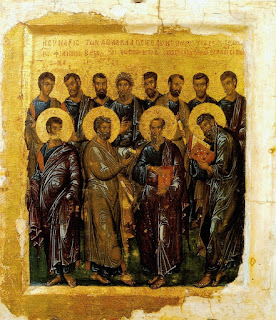
In his Rule , Saint Benedict instructs the abbot to call the community together whenever there is important business to discuss: “Let the Abbot call together the whole community and state the matter to be acted upon. Then, having heard the brethren's advice, let him turn the matter over in his own mind and do what he shall judge to be most expedient. The reason we have said that all should be called for counsel is that the Lord often reveals to the younger what is best” (Ch. 3). As with so many of the Rule’s precepts, Benedict bases his teachings on a balanced understanding of the human person and community dynamics, as well as the experience of the broader Church.   Synaxis of the Apostles 14th century icon  In the Acts of the Apostles , Saint Luke presents the first generation of believers as living an almost idyllic existence: “They devoted themselves to the teaching of the Apostles and to the communal life, to the breaking of the bread and to the prayers… A...