Posts

Showing posts with the label Jesuits

The Twelfth Sunday of Ordinary Time: Knowing the Value of Little Things

Image
“Are not two sparrows sold for a small coin? Yet not one of them falls to the ground without your Father’s knowledge. Even all the hairs of your head are counted. So do not be afraid; you are worth more than many sparrows.” —Matthew 10:29-31 In 1618, a young Jesuit from Diest, Belgium, traveled on foot to Rome to study at the famous Roman College. John Berchmans was, in many ways, an unremarkable young religious. The son of a shoemaker, his life was like that of other children of the working classes, but John’s natural intelligence helped him stand out from his peers and he was given an opportunity to study, which ultimately led him to religious life and to preparations for the priesthood. After distinguishing himself in philosophical studies, John was chosen by his superiors to take part in a public debate, but became ill before it had ended. As the young seminarian lay on his deathbed, he clasped his crucifix, his rosary, and the Jesuit Rule and said: “These are my three t...
Saint Bernardino Realino: A Model of Gentleness and Patience

Image
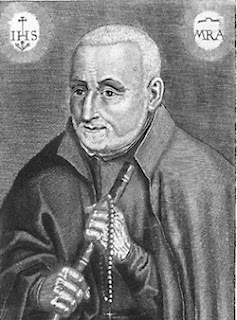
The spirit of the Lord God is upon me; because the L ord has anointed me; He sent me to bring good news to the afflicted, to bind up the brokenhearted, to proclaim liberty to the captives, release to prisoners, to announce a year of favor from the L ord and a day of vindication by our God. —Isaiah 61:1-2   Bernardino Luigi Realino was born in Carpi, Italy, in 1530. The son of a wealthy and influential family, he attended the academy in Modena, Italy, and went on to study the arts and medicine in Bologna. After finishing his studies, he considered becoming a physician. Instead, he chose to study canon and civil law (apparently, at the request of a lady he had fallen in love with and who thought he would have made a good lawyer). For his part, Bernardino recognized that his legal studies would give him a solid foundation for a career in government or public administration. After completing his doctorate in 1556, he became an auditor and general superint...

The Holy Name of Jesus: What's In a Name?

Image
At the name of Jesus, every knee should bend, of those in heaven and on earth and under the earth, and every tongue confess That Jesus Christ is Lord, to the glory of God the Father. — Philippians 2:10-11 Buried deep within the Catechism of the Catholic Church , in the fourth part—“Christian Prayer”—are three brief paragraphs that teach us something fundamental about prayer: 2664: There is no other way of Christian prayer than Christ. Whether our prayer is communal or personal, vocal or interior, it has access to the Father only if we pray "in the name" of Jesus. The sacred humanity of Jesus is therefore the way by which the Holy Spirit teaches us to pray to God our Father. 2665: The prayer of the Church, nourished by the Word of God and the celebration of the liturgy, teaches us to pray to the Lord Jesus. Even though her prayer is addressed above all to the Father, it includes in all the liturgical traditions forms of prayer addressed to Christ. ...

Monday of the First Week of Advent - St. Francis Xavier

Image
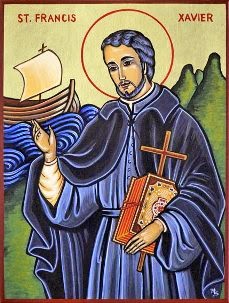
Many will come from the east and west, and will recline with Abraham, Isaac, and Jacob at the banquet of the Kingdom of Heaven. - Matthew 8:11 In the First Reading and Gospel of today’s Mass , we hear, as if for the first time, the promise of the Lord’s Advent: “For over all, the Lord’s glory will be a shelter and protection.” The promised Messiah, the Long-Awaited One of Israel, comes to offer salvation for all God’s children. Isaiah saw the vision of a world cleansed from its fear and sin, a world where God’s glory would be manifest to all. In Jesus, this promise is fulfilled.     Opening our hearts to hear this promise in a new way this Advent, we remember the great missionary, Saint Francis Xavier . Inspired by no other motive than a desire to spread the Gospel, this holy, simple priest left the security of his Jesuit community to set out on a mission that took him to India, numerous islands in the South Pacific, Japan, and finally, to a small island off the...

Saint Margaret Mary and Learning About Love

Image
Blessed be the God and Father of our Lord Jesus Christ, who has blessed us in Christ with every spiritual blessing in the heavens, as he chose us in him, before the foundation of the world, to be holy and without blemish before him. In love he destined us for adoption to himself through Jesus Christ, in accord with the favor of his will, for the praise of the glory of his grace that he granted us in the beloved. —Ephesians 1:2-3 On December 27, 1673, a nun of the Visitation Monastery in Paray-le-Monial, France, was gifted with an experience of the Divine that left an indelible mark on spirituality. Years later, remembering that vision, she wrote: “The Lord said to me, ‘My Divine Heart is so passionately in love with humanity that it can no longer contain within itself the flames of its ardent love. It must pour them out through [you], and manifest itself to them with its precious treasures, which contain all the graces which they need to be saved.” This Divine Love is what devotion...

Aloysius: A Friend and a Brother

Image
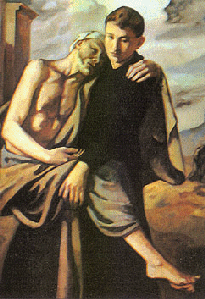
I first read about Aluigi Gonzaga when I was about 9 years old. Leafing through an old St. Joseph’s Daily Missal that I had found in my grandmother’s cedar chest, I saw page after page of saints’ names and the prayers assigned to various days of the year. When I turned to June 21, I came across an image of a Renaissance prince (wearing a ruffled collar, breeches, and hose) kneeling before a statue of Mary. Although the short bio that preceded the prayers of the Mass assigned for the day didn’t provide much information, something resonated within me. That was the moment when I began a relationship with the young man who is now remembered as Saint Aloysius Gonzaga . Today, when most people hear the name “Gonzaga” they think of the great Jesuit University in Spokane, Washington. For Reformation-era Europeans, the name of Gonzaga meant something very different. Distant relatives of the Holy Roman Emperors and counted among the greatest families of Italy, Spain, and all of Europe, the...

The Martyrs of September

Image
On September 2, the Church commemorates 191 martyrs, commonly known as the "Martyrs of September," who were killed in four prisons in Paris, France, between September 2 and 3, 1792.  The Massacre of the Priests by H. de la Charlerie   Following the promulgation of the 'Civil Constitution on the Clergy' by the National Constituent Assembly (the government of the first stages of the French Revolution) in 1790, any cleric who refused to deny Papal authority and affiliate with the state-sponsored church in France was imprisoned as a traitor. All religious communities were dissolved by the government on August 15, 1792. Later that month, the citizens of Paris heard rumors of a possible invasion of the city by the Duke of Brunswick and of a mass breakout of those in its prisons, where the hundreds of clerics who refused to take the oath of allegiance were being housed alongside common criminals. Enflamed by revolutionary zeal, and unchecked by government authorit...

Saint Aloysius: A Saint for Seekers

Image
Born in 1568, Aloysius was the son and heir of the powerful Gonzaga family of Castiglione and a prince of the Holy Roman Empire. At an early age he manifested habits of prayer and virtue which formed a strong spiritual foundation for his later life. Sometimes given to excess in his penances, he was nonetheless unrelenting in his desires to please God and see God's will above all things. Feeling called to religious life, he entered into a battle of wills with his father, who refused to allow his son to abdicate his title and the right of succession. However, after years of prayer, sacrifice, and struggle, Aloysius was given the necessary permission by his family to enter the Society of Jesus at Rome. Well-liked by his superiors and confreres, he was an outstanding student and desired to serve in the Society's Asian missions. In the spring of 1591, he contracted the plague after carrying a dying man from the street to a hospital. Aloysius died during the night of June 20-21, afte...