Posts

Showing posts with the label Philippians

Go and Sin No More: The Fifth Sunday of Lent
Image
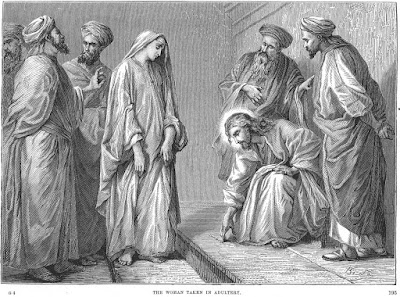
The scribes and the Pharisees brought a woman who had been caught in adultery and made her stand in the middle. They said to him, “Teacher, this woman was caught in the very act of committing adultery. Now in the law, Moses commanded us to stone such women. So what do you say?” They said this to test him, so that they could have some charge to bring against him.   Jesus bent down and began to write on the ground with his finger.But when they continued asking him, he straightened up and said to them, “Let the one among you who is without sin be the first to throw a stone at her” …   Jesus [said to the woman], “Woman, where are they? Has no one condemned you?” She replied, “No one, sir.”   Then Jesus said, “Neither do I condemn you. Go, and from now on do not sin any more.” — John 8:1-7, 10-11 Blessed Charles de Foucauld (d. 1916), a soldier and explorer, monk and priest, missionary and martyr, once wrote, “We are all children of the Most High. All of u...

"Prepare the Way of the Lord": The Second Sunday fo Advent

Image
John went throughout the whole region of the Jordan, proclaiming a baptism of repentance for the forgiveness of sins, as it is written in the book of the words of the prophet Isaiah: “A voice of one crying out in the desert: ‘Prepare the way of the Lord.’” —Luke 1:3-4   We live in an age of hashtags, sound bites, and blogs, in a world of competing viewpoints and clamoring voices. It can sometimes be difficult to discern what is really worthy of our attention. This is especially true in these days as our nation looks toward the next presidential election and as we collectively try to make sense of the mass shootings in Colorado Springs and San Bernardino and the ongoing acts of terror here at home and in the Middle East. We place blame, make excuses, and dig into our ideological trenches, all-too-often losing sight of the many goods—and lives—that are sacrificed on the altars of politics and partisanship. If we settle for the mediocrity of sound bites and hal...

God and Mammon: A Lesson in Stewardship

Image
There is a well-known phrase that is often used as a sort of “proof text” against the vice of greed: “You cannot love both God and money.” At the surface, God and money aren’t incompatible. In fact, Saint Augustine even encouraged people to provide for their eternal happiness by using the goods of the earth (cf. Discourses 359, 10). But the parable of the dishonest steward, from which this quotation is adapted, doesn’t use the word “money” (which does appear in certain popular translations of Scripture). Rather, the word used in the parable is “mammon,” a Phoenician term for economic security and success in business. Reflecting on mammon , Pope Emeritus Benedict XVI said, “we might say that riches are shown as the idol   to which everything is sacrificed in order to attain one’s own material success; hence, this economic success becomes a person’s true god.”   The Dishonest Steward from  Evangelicae Historiae Imagines (1594)   More than just making an ...