Posts

Showing posts with the label Saint Paul

For the Fourth Sunday of Advent (Cycle B, 2020)

Image
  Mary said, "Behold, I am the handmaid of the Lord. May it be done to me according to your word." —Luke 1:38 The Gospels do not relate a single word spoken by Joseph, the husband of Mary. He is a silent, protecting figure standing in the shadows during the Season of Advent, coming into view only in the final days of this season of watching and waiting. And, while we do hear from Mary in the gospels of Luke and John, few of her words have come down to us.  Despite the fact that we hear so little from the parents of Jesus, we can nevertheless recognize one particular virtue that both shared: obedience.  “Obedience” isn’t a particularly popular word in our culture, including within the Church. Sadly, too many people have to come to associate obedience with some sort of blind submission. Instead, if we look at the history of the word, we see that it comes from two Latin words, ob and audire , and our English word “obedience” means to listen or to hear.  This sense of l...

Seeking the Transcendant

Image
How can we begin to grow and see in the events of life the hand of God, and see in each other the face of Christ? Saint. Paul suggests the answer: Let your thoughts be on heavenly things, not on the things that are in the earth. (Colossians 3:2) That is the secret. Look beyond and above the things of men and earth. It is there — paradoxically, surprisingly and unexpectedly — that we begin to see the hand of God in the events of daily life, the face of Christ dimly outlined among those whom we know and love. Stained glass window by Marc Chagall in All Saints Church in Tudely, England We have to seek constantly the transcendent, plunge more deeply into the mystery that is God, and worship him more reverently. Like him we must establish and deepen community life. We must refuse to be intimidated by opposition or oppression. We must seek every means of communicating freely with the peoples of today who, no matter under what political system they live, are sta...

Using the Time We Have

Image
What is the purpose of the Christian life? Or, we might ask even more simply: What’s the point? As the Church Year comes to an end, this essential question is brought into sharp focus. The answer is as simple as it might be unpopular: because we’re waiting for the fulfillment of time and of hope-filled promises of an untold future. We are awaiting the return of Christ. I would go so far as to say that if we’re not watching and waiting in hopeful expectation, then something vital is missing from our individual faith.   The Last Judgment from the Sistine Chapel by Michelangelo depicts Christ the Judge surrounded by Mary and the Saints Many Christians become immediately uncomfortable with talk of Heaven and hell, death and judgment. And, while the naïve concepts of heaven's “streets paved with gold” and hell’s "fire" shape the lives of some believers, these simplistic Sunday school images (could we say "threats"?) aren’t what we are about as Christ...

The Martyrs of Nagasaki: Living the Mystery of the Cross

Image
Through the law I died to the law, that I might live for God. I have been crucified with Christ, yet I live, no longer I, but Christ lives in me; insofar as I now live in the flesh, I live by faith in the Son of God who has loved me and given himself up for me. – Galatians 2:19-20 When Saint Paul wrote his letter to the Galatians, he was reaching out to a community of Christians that he had known personally, and he offers an impassioned appeal for them to live according to the message he had preached to them. At some point, new teachers had come to their community and they had attacked Paul’s character and teachings. In no uncertain terms, Paul defends his authority as an apostle and teacher and he reminds the Galatians that Christians live only by faith in Christ, who is the centerpiece of our faith. When Paul speaks of Christ, he is rejoicing in the love that he has received from Christ. In Saint Paul and the New Evangelization , Ronald Witherup notes, “This is the kind of expe...

A Communion of Saints

Image
The Second Letter to the Thessalonians, which is among the source texts used for the Readings of the Thirty-Second Sunday of Ordinary Time (Cycle C) is something of a problematic biblical text. Although it has traditionally been attributed to Saint Paul, writing with Saint Barnabas and Saint Silvanus/Silas (cf. 2 Thess 1:1 ), most modern scholars believe that this text (among others) was written several years after Paul’s martyrdom. Whether this letter was written by Paul or by those who had been formed by the Apostle is, however, in many ways irrelevant to the meaning of the text for the Church today. The text itself, which was certainly known to Marcion and Saint Polycarp (in the mid-second century), describes a local community that was experiencing persecution or dangers from heretical (i.e. gnostic) movements and which was at danger of losing its focus on the Faith that Paul and his collaborators had handed over to the community by their preaching and witness (cf. Raymond Brown,...

A Sunday at the End of September

Image
The end of September and beginning of October are marked by a series of memorials and commemorations that serve to highlight the catholicity of the Church. From the Bohemian ruler Wenceslaus and the Filipino layman Lawrence Ruiz (a husband and father) and his martyred companions from Japan (on September 28) to the great biblical scholar and Father of the Church Jerome (on September 30), the cloistered missionary-at-heart Thérèse of Liseux (on October 1) and Carthusian founder Bruno (on October 6), to the Indiana foundress Theodora Guerin (on October 3) and the Louisana pastor and missionary Francis Seelos (on October 5) to the beloved Francis of Assisi (October 4), these days (which also include celebrations of the Archangels Michael, Gabriel, and Raphael [September 29] and the Guardian Angels [October 2]) remind us that the possibility for true holiness isn’t limited to one way of life, gender, or historical epoch. Saint Theodora Guerin (d. 1856) The Foundress of the ...

More Than We Imagine

Image
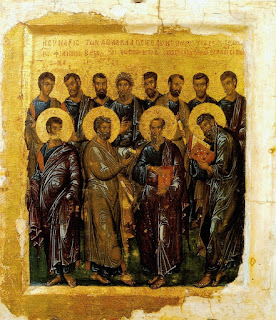
In his Rule , Saint Benedict instructs the abbot to call the community together whenever there is important business to discuss: “Let the Abbot call together the whole community and state the matter to be acted upon. Then, having heard the brethren's advice, let him turn the matter over in his own mind and do what he shall judge to be most expedient. The reason we have said that all should be called for counsel is that the Lord often reveals to the younger what is best” (Ch. 3). As with so many of the Rule’s precepts, Benedict bases his teachings on a balanced understanding of the human person and community dynamics, as well as the experience of the broader Church.   Synaxis of the Apostles 14th century icon  In the Acts of the Apostles , Saint Luke presents the first generation of believers as living an almost idyllic existence: “They devoted themselves to the teaching of the Apostles and to the communal life, to the breaking of the bread and to the prayers… A...