Posts

Showing posts with the label Ordinary Time

The Second Sunday of Ordinary Time (Cycle B, 2021)

Image
John was standing with two of his disciples, and as he watched Jesus walk by, he said, “Behold, the Lamb of God.” The two disciples heard what he said and followed Jesus. —John 1:35-37 If you’re anything like me, the recent celebrations of Epiphany and the Baptism of the Lord have already faded into memory. I find myself continually distracted by the ceaseless news cycle, the unrest across the nation, the continuing devastation being wreaked by the coronavirus pandemic, as well the “quick succession of busy nothings” of my own life (to borrow a phrase from Jane Austen). And now, here we are in Ordinary Time again, with a very adult Jesus in the early days of his ministry. The Gospel assigned for the Second Sunday of Ordinary Time opens with John the Baptist in conversation with some of his disciples. In a sense, John helps to form a bridge between Advent and Christmas and these first days of Ordinary Time (see Pope Francis, Angelus Address for January 14, 2018). John will...

The Feast of the Baptism of the Lord (Year B, 2021)

Image
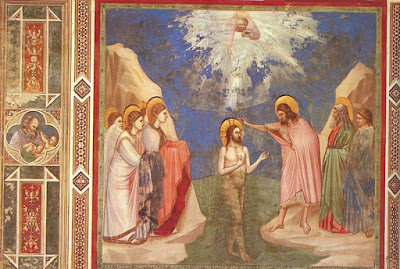
It happened in those days that Jesus came from Nazareth of Galilee  and was baptized in the Jordan by John. On coming up out of the water he saw the heavens being torn open  and the Spirit, like a dove, descending upon him. And a voice came from the heavens,  "You are my beloved Son; with you I am well pleased."   —Mark 1:9-11 To be baptized is an act of humility. After all, no one baptizes himself or herself. In accepting John’s baptism, Jesus fully embraced what it means to be a human person, with all of humanity’s weakness, limitations, and suffering.  That Jesus, the Incarnate Word, humbled himself in this way shows that he chose humility as the way he would redeem us. The Baptism of Christ by Giotto (1305) As we have heard time and again in these Christmas days, the Savior of the world did not come with any sort of fanfare or grandeur. He came quietly into the world as a baby, the lowest and the least of humanity. Then, after spending thirty years in an...

For the 30th Sunday in Ordinary Time (Year A, 2020)

Image
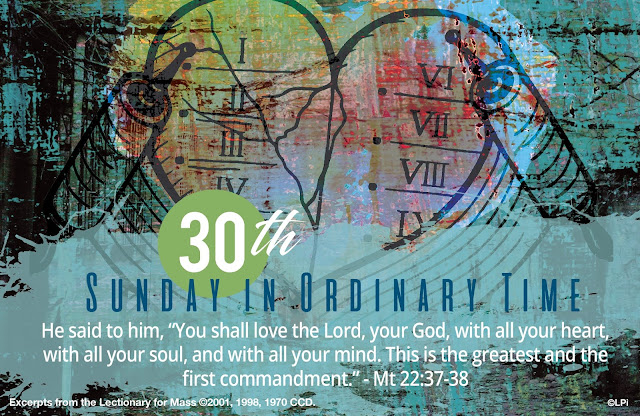
“The whole law and the prophets depend on these two commandments." —Matthew 22:40   One of the assignments that students find most challenging is condensing a chapter or book into a brief, concise summary. It’s quite difficult to take the words and ideas of another person, reflect on them, discern what is most important in the text, and then present the most important points or themes in your own words. And yet, as teachers and professors can attest, this is an invaluable way of helping students hold on to what is most important for their studies. In a sense, this is the task that is being presented to Jesus in today’s Gospel. On this Thirtieth Sunday of Ordinary Time, our Gospel is a continuation of the passages we have heard over the past two Sundays. Jesus is in conversation with the religious leaders of the Jewish people and they continue to question him, hoping to trip him up by asking for impossible answers. In this Sunday’s passage, Jesus is asked which of the com...

For the 28th Sunday in Ordinary Time (Cycle A, 2020)

Image
“The king said to him, 'My friend, how is it that you came in here without a wedding garment?' But he was reduced to silence. Then the king said to his attendants, 'Bind his hands and feet, and cast him into the darkness outside, where there will be wailing and grinding of teeth.' Many are invited, but few are chosen." —Matthew 22:12-14   This is a season of invitations. As the end of October approaches, many of us will be invited to Halloween parties and numerous parishes will send out information about special All Saints’ Day and All Souls Day services remembering those who have died in the past year. Then, only a short time later family and friends will begin making plans for Thanksgiving. Few of us will have a chance to take a breath before the invitations begin to roll in for the pre-Christmas parties. It almost seems natural, then, that our Gospel this Sunday is a parable that begins with an invitation to a party. In this passage, Jesus tells t...

For the 25th Sunday in Ordinary Time (Cycle A, 2020)

Image
 " He said to one of them in reply, 'My friend, I am not cheating you. Did you not agree with me for the usual daily wage? Take what is yours and go. What if I wish to give this last one the same as you?'" —Matthew 20:13-14 Even before the outbreak of the pandemic-when employment and economic uncertainty weren't as widespread as they are now-it wasn't uncommon to see groups of men and women standing in groups in the parking lots of hardware and home improvement stores like Home Depot and Lowes. I never gave them much thought until a friend explained who they were: these were day laborers who were hoping that a contractor or someone needing help with a home repair project would hire them for the day or, at the least, for a few hours.   These people are continuing a tradition that is found in nearly every culture and, as we see in this Sunday's Gospel , was certainly common in Jesus’ day. One of my Salvatorian confreres who had worked in Arizona an...

For the 24th Sunday of Ordinary Time (Year A, 2020)

Image
Peter approached Jesus and asked him, "Lord, if my brother sins against me, how often must I forgive? As many as seven times?" Jesus answered, "I say to you, not seven times but seventy-seven times.” —Matthew 18:21-22 A Benedictine monk whom I greatly admire and who has also become a good friend through the years once said to me, “The kindest thing you can do for some people is to give them something to be angry about.” Although we laughed at his insight at the time, over the years I’ve realized there is truth in his words. Sometimes, some people just want something to be angry about. Sometimes we are just looking for a fight. Other times—and I’m guilty of this—we look for an excuse to justify the chip we already have on our shoulder. And, the fact of the matter is, we generally don’t have far to look to find something to be angry about. Anger is a reality in life. However, as we know, anger is like any other emotion and can ultimately be used for good or fo...

For the 23rd Sunday of Ordinary Time (Year A, 2020)

Image
Jesus said to his disciples:  "If your brother sins against you,  go and tell him fault between you and him alone. If he listens to you, you have won over your brother."--Matthew 18:15 It can be easy for us to look back on the stories found in the gospels and imagine that those women and men listening to Jesus we ideal disciples, living in perfect harmony with one another. If we read the Acts of the Apostles and the letters of Saint Paul, however, we quickly realize that this idyllic community was never a reality. From the earliest days, the Church experienced divisions, disagreements, and dis-ease as believers tried to figure out how to live out the teachings of Jesus individually and as a community of believers. In fact, many of the difficulties we experience in our parishes or religious communities today are the same sorts of challenges faced by those first generations of Christians. The Gospel of Matthew was composed sometime around the year 85. By this time, the ...

The Twelfth Sunday of Ordinary Time: Knowing the Value of Little Things

Image
“Are not two sparrows sold for a small coin? Yet not one of them falls to the ground without your Father’s knowledge. Even all the hairs of your head are counted. So do not be afraid; you are worth more than many sparrows.” —Matthew 10:29-31 In 1618, a young Jesuit from Diest, Belgium, traveled on foot to Rome to study at the famous Roman College. John Berchmans was, in many ways, an unremarkable young religious. The son of a shoemaker, his life was like that of other children of the working classes, but John’s natural intelligence helped him stand out from his peers and he was given an opportunity to study, which ultimately led him to religious life and to preparations for the priesthood. After distinguishing himself in philosophical studies, John was chosen by his superiors to take part in a public debate, but became ill before it had ended. As the young seminarian lay on his deathbed, he clasped his crucifix, his rosary, and the Jesuit Rule and said: “These are my three t...

The Fifth Sunday of Ordinary Time and a Lesson in Humility

Image
Getting into one of the boats, the one belonging to Simon, Jesus asked him to put out a short distance from the shore. Then he sat down and taught the crowds from the boat. After he had finished speaking, he said to Simon, “Put out into deep water and lower your nets for a catch.” Simon said in reply, “Master, we have worked hard all night and have caught nothing, but at your command I will lower the nets.” When they had done this, they caught a great number of fish and their nets were tearing. —Luke 5:3–6 This past week, as I was reflecting on this Sunday’s Gospel and thinking about what I would write in this reflection, I happened to have a conversation with another member of my religious community , during which he shared a question he recently asked the members of his parish in a daily homily: “How do you respond when someone confronts you about something you’ve done wrong?” It’s a good question. He shared three possible responses with his parishioners. “First,” he said, ...

A Season of Enlightenment: The Third Sunday in Ordinary Time

Image
Since many have undertaken to compile a narrative of the events that have been fulfilled among us, just as those who were eyewitnesses from the beginning and ministers of the word have handed them down to us, I too have decided, after investigating everything accurately anew, to write it down in an orderly sequence for you, most excellent Theophilus, so that you may realize the certainty of the teachings you have received. —Luke 1:1-4   “There are three stages of spiritual development: the carnal, the spiritual, and the divine,” an old monk once explained to a novice. “What is the carnal stage?” the novice asked. “That’s the stage,” the old monk said, “when trees are seen as trees and mountains are seen as mountains.” “And the spiritual?” the novice asked eagerly. “That’s when we look more deeply into things. Then trees are no longer trees and mountains are no longer mountains,” the old monk answered. “And the divine?” the novice asked breathlessly. “Ah,” the old monk sa...

Cana and Pontmain: "Do Whatever He Tells You"

Image
In the year 1871, France was being devastated by the brutality of the Franco-Prussian War. On the night of January 17, as German forces approached the mountain village of Pontmain, two young boys, Eugéne and Joseph, were helping their faith in the family barn. Eugéne looked outside and saw an apparition of a woman in the star-studded sky smiling at him. The woman, clothed in a blue gown covered with golden stars, wore a black veil under a golden crown.    A contemporary icon of Our Lady of Pontmain As the vision continued, the villagers—including two girls, Françoise and Jeanne-Marie—gathered outside the barn while the parish priest and sisters from the parish school led the people in singing hymns and in reciting the rosary; only the children of the village were able to see the “beautiful lady.” Eventually, a banner appeared beneath the woman’s feet, on which a message appeared: “But pray, my children. God will you in time. My son allows himself to be touched.” Toward...

A Baptism and a New Beginning

Image
In her book, The Jesus Wisdom , Cythia Bourgeault writes: Seeking leads to finding, yes, but the result of that finding is often to plunge you into confusion and disorientation as the new information rattles the cage of your old paradigm. Only gradually, as you can make room for what this gospel calls "wonder," does a new universe begin to knit itself together around you, and you come to rest on a new foundation. The Feast of the Baptism of the Lord, which marks the end of the Christmas Season, is a feast that is actually part of the broader celebration of the Epiphany of the Lord. Although we in the West associate the great solemnity of the Epiphany with the three "kings" and their gifts of gold, frankincense, and myrrh, the Early Church saw the Epiphany as including three great mysteries in the life of Jesus: the visit of the Magi, the Baptism of Jesus, and the wedding at Cana (the occasion of Jesus' first miracle). But of these mysteries, the Baptism of ...