Posts

Showing posts with the label Saint Luke

For the Solemnity of the Epiphany (2021)

Image
 And behold, the star that they had seen at its rising preceded them,  until it came and stopped over the place where the child was. They were overjoyed at seeing the star,  and on entering the house they saw the child with Mary his mother. They prostrated themselves and did him homage. Then they opened their treasures  and offered him gifts of gold, frankincense, and myrrh .  —Matthew 2:9b-11 When Saint Luke wrote his account of the birth of Jesus, he spoke of shepherds tending their flocks by night. Inspired an angelic messenger and the multitude of the heavenly host with their songs of God’s glory, these shepherds “went in haste and found Mary and Joseph, and the infant lying in the manger” (Luke 2:16). We hear this story in the gospels proclaimed in the Masses of Christmas “ During the Night ” and “ at Dawn .”    Saint Matthew’s account of the birth of Jesus has a very different tone. Concerned as he is with demonstrating how Jesus was the fulfillm...

The Mysterious Tug of Evil and the First Sunday of Lent

Image
Filled with the Holy Spirit, Jesus returned from the Jordan and was led by the Spirit into the desert for forty days, to be tempted by the devil. He ate nothing during those days, and when they were over he was hungry. The devil said to him, “If you are the Son of God, command this stone to become bread”… When the devil had finished every temptation, he departed from him for a time. —Luke 4:1-4, 13     In his novel Brighton Rock , Graham Greene wrote, “You can’t conceive, my child, nor can I or anyone, the appalling strangeness of the mercy of God.” Lent is the time when the Church pauses to reflect on the reality of that mercy. And, when weighed against human standards, God’s mercy is appallingly strange because it costs us so little: God asks only that we surrender to his love and mercy. For most of us, this process of surrender is one which unfolds gradually over the course of a life of prayer, service, struggle, and even setbacks. However, the temptation to cho...

A Season of Enlightenment: The Third Sunday in Ordinary Time

Image
Since many have undertaken to compile a narrative of the events that have been fulfilled among us, just as those who were eyewitnesses from the beginning and ministers of the word have handed them down to us, I too have decided, after investigating everything accurately anew, to write it down in an orderly sequence for you, most excellent Theophilus, so that you may realize the certainty of the teachings you have received. —Luke 1:1-4   “There are three stages of spiritual development: the carnal, the spiritual, and the divine,” an old monk once explained to a novice. “What is the carnal stage?” the novice asked. “That’s the stage,” the old monk said, “when trees are seen as trees and mountains are seen as mountains.” “And the spiritual?” the novice asked eagerly. “That’s when we look more deeply into things. Then trees are no longer trees and mountains are no longer mountains,” the old monk answered. “And the divine?” the novice asked breathlessly. “Ah,” the old monk sa...

Saint Cornelius the Centurion: The Light of Grace

Image
People will come from the east and west and from the north and the south and will recline at table in the Kingdom of God. For behold, some are last who will be first, and some are first who will be last. —Luke 13:20-30 What little we know about Saint Cornelius comes from chapters 10 and 11 of the Acts of the Apostles . However, his brief story marks an important shift in the life of the Early Church: through his encounter with Cornelius, Saint Peter was convinced that the Gospel message must be taken to the Gentiles. In Acts , Saint Luke tells us that Cornelius was the commander of a cohort of Roman soldiers and that he was “devout and God-fearing along with his whole household” (10:2). Luke continues by pointing out that Cornelius was generous in giving alms to the Jewish people and that he was a man devoted to God. These are important details, especially when we remember that the Jewish people were subjects of the Roman Empire. One afternoon, Cornelius received a...

Saint Luke, Patron of Artists

Image
On this Feast of Saint Luke, we pause to reflect on the special vocation of the Evangelists to hand on the Good News of Jesus Christ. But, today's Feast, honoring the patron of artists, also reminds us of the essential place that literature, the visual arts, and music have always had in the spread of the Gospel in all times and places. Saint John Paul II highlighted this in his Letter to Artists , which was issued in preparation for the Great Jubilee, on Easter Sunday, April 4, 1999: In order to communicate the message entrusted to her by Christ, the Church needs art. Art must make perceptible, and as far as possible attractive, the world of the spirit, of the invisible, of God. It must therefore translate into meaningful terms that which is in itself ineffable. Art has a unique capacity to take one or other facet of the message and translate it into colours, shapes and sounds which nourish the intuition of those who look or listen. It does so...

Fulfill Your Ministry: A Reflection on World Mission Sunday

Image
During this Year of Faith, the theme of the New Evangelization has largely dominated conversations within the Church. I have been especially struck by how often the themes of mission and evangelization are misunderstood or ignored by many groups And, this isn’t necessarily a Catholic phenomenon; many Protestant communions shy away from the work of “evangelism” because of fear that they will be perceived as proselytizing or as having an out-of-check zeal. Beyond the fact that today (October 20) is World Mission Sunday , Pope Francis spoke about the apostolic nature of the Church in his most recent General Audience this past Wednesday. When   you also consider that these days the liturgical calendar has placed before us several saints who were missionaries and catechists (including Saint Luke the Evangelist , Blesseds Daudi Okelo and JildoIrwa , Saint Isaac Jogues and the other North American Martyrs , Blessed JohnPaul II , Saint John Capistrano , and Saint Anthony Mary Clare...

Dynamic Gratitude

Image
The Gospel of Luke includes a transitional text ( 8:1-3 ) that we might be tempted to dismiss because of its simplicity. Saint Luke presents Jesus, the itinerant preacher, travelling from village to village, “proclaiming the good news of the Kingdom of God.” Traveling with Jesus are the Twelve and a group of women, including Mary Magdalene, Joanna, and Susanna, among others.   That the evangelist includes the names of these women is not an insignificant detail. Along with Mary (the wife of Cleopas), Salome (the mother of James and John), and Martha of Bethany, these women are celebrated as the “ Myrrhbearers ,” a name that honors the part they played as witnesses of the Lord’s Resurrection. Tradition holds that these were the women who prepared the body of Jesus for burial and who were among the first to announce the Good News on that Easter morning.   Myrrh, an essential element in preparing a body for burial, is a costly resin. The generosity of these women, whose ...

More Than We Imagine

Image
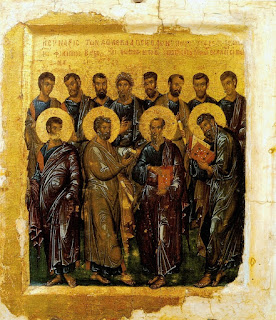
In his Rule , Saint Benedict instructs the abbot to call the community together whenever there is important business to discuss: “Let the Abbot call together the whole community and state the matter to be acted upon. Then, having heard the brethren's advice, let him turn the matter over in his own mind and do what he shall judge to be most expedient. The reason we have said that all should be called for counsel is that the Lord often reveals to the younger what is best” (Ch. 3). As with so many of the Rule’s precepts, Benedict bases his teachings on a balanced understanding of the human person and community dynamics, as well as the experience of the broader Church.   Synaxis of the Apostles 14th century icon  In the Acts of the Apostles , Saint Luke presents the first generation of believers as living an almost idyllic existence: “They devoted themselves to the teaching of the Apostles and to the communal life, to the breaking of the bread and to the prayers… A...