Posts

Showing posts with the label discipleship

The Second Sunday of Ordinary Time (Cycle B, 2021)

Image
John was standing with two of his disciples, and as he watched Jesus walk by, he said, “Behold, the Lamb of God.” The two disciples heard what he said and followed Jesus. —John 1:35-37 If you’re anything like me, the recent celebrations of Epiphany and the Baptism of the Lord have already faded into memory. I find myself continually distracted by the ceaseless news cycle, the unrest across the nation, the continuing devastation being wreaked by the coronavirus pandemic, as well the “quick succession of busy nothings” of my own life (to borrow a phrase from Jane Austen). And now, here we are in Ordinary Time again, with a very adult Jesus in the early days of his ministry. The Gospel assigned for the Second Sunday of Ordinary Time opens with John the Baptist in conversation with some of his disciples. In a sense, John helps to form a bridge between Advent and Christmas and these first days of Ordinary Time (see Pope Francis, Angelus Address for January 14, 2018). John will...


For the Fourth Sunday of Advent (Cycle B, 2020)

Image
  Mary said, "Behold, I am the handmaid of the Lord. May it be done to me according to your word." —Luke 1:38 The Gospels do not relate a single word spoken by Joseph, the husband of Mary. He is a silent, protecting figure standing in the shadows during the Season of Advent, coming into view only in the final days of this season of watching and waiting. And, while we do hear from Mary in the gospels of Luke and John, few of her words have come down to us.  Despite the fact that we hear so little from the parents of Jesus, we can nevertheless recognize one particular virtue that both shared: obedience.  “Obedience” isn’t a particularly popular word in our culture, including within the Church. Sadly, too many people have to come to associate obedience with some sort of blind submission. Instead, if we look at the history of the word, we see that it comes from two Latin words, ob and audire , and our English word “obedience” means to listen or to hear.  This sense of l...

For the 24th Sunday of Ordinary Time (Year A, 2020)

Image
Peter approached Jesus and asked him, "Lord, if my brother sins against me, how often must I forgive? As many as seven times?" Jesus answered, "I say to you, not seven times but seventy-seven times.” —Matthew 18:21-22 A Benedictine monk whom I greatly admire and who has also become a good friend through the years once said to me, “The kindest thing you can do for some people is to give them something to be angry about.” Although we laughed at his insight at the time, over the years I’ve realized there is truth in his words. Sometimes, some people just want something to be angry about. Sometimes we are just looking for a fight. Other times—and I’m guilty of this—we look for an excuse to justify the chip we already have on our shoulder. And, the fact of the matter is, we generally don’t have far to look to find something to be angry about. Anger is a reality in life. However, as we know, anger is like any other emotion and can ultimately be used for good or fo...

For the 23rd Sunday of Ordinary Time (Year A, 2020)

Image
Jesus said to his disciples:  "If your brother sins against you,  go and tell him fault between you and him alone. If he listens to you, you have won over your brother."--Matthew 18:15 It can be easy for us to look back on the stories found in the gospels and imagine that those women and men listening to Jesus we ideal disciples, living in perfect harmony with one another. If we read the Acts of the Apostles and the letters of Saint Paul, however, we quickly realize that this idyllic community was never a reality. From the earliest days, the Church experienced divisions, disagreements, and dis-ease as believers tried to figure out how to live out the teachings of Jesus individually and as a community of believers. In fact, many of the difficulties we experience in our parishes or religious communities today are the same sorts of challenges faced by those first generations of Christians. The Gospel of Matthew was composed sometime around the year 85. By this time, the ...

The Feast of Saint Thomas the Apostle

Image
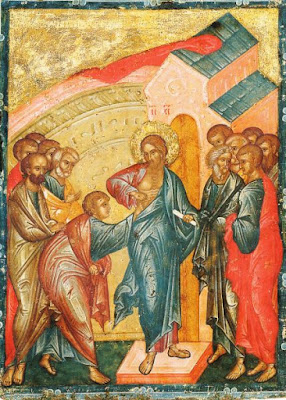
All that is known for certain about Thomas comes from the New Testament. He is mentioned as one of the twelve apostles in all four Gospels and is nicknamed Didymus, “the twin,” in John’s Gospel. It was a “doubting” Thomas who refused to believe that Jesus had risen from the dead until he had seen him with his own eyes and put his finger into his wounds; this prompted Jesus’ response, “Doubt no longer but believe,” to which Thomas replied, “My Lord and my God” ( John 20:24-29 ). Reflecting on this moment, Saint Gregory the Great wrote, “The disbelief of Thomas has done more for our faith than the faith of the other disciples. As he touches Christ and is won over to belief, every doubt is cast aside and our faith is strengthened. So the disciple who doubted, then felt Christ’s wounds, becomes a witness to the reality of the resurrection.” Tradition states that Saint Thomas preached the Gospel to the Parthians, Medes, and Persians, eventually making his way to India where he ...

The Twelfth Sunday of Ordinary Time: Knowing the Value of Little Things

Image
“Are not two sparrows sold for a small coin? Yet not one of them falls to the ground without your Father’s knowledge. Even all the hairs of your head are counted. So do not be afraid; you are worth more than many sparrows.” —Matthew 10:29-31 In 1618, a young Jesuit from Diest, Belgium, traveled on foot to Rome to study at the famous Roman College. John Berchmans was, in many ways, an unremarkable young religious. The son of a shoemaker, his life was like that of other children of the working classes, but John’s natural intelligence helped him stand out from his peers and he was given an opportunity to study, which ultimately led him to religious life and to preparations for the priesthood. After distinguishing himself in philosophical studies, John was chosen by his superiors to take part in a public debate, but became ill before it had ended. As the young seminarian lay on his deathbed, he clasped his crucifix, his rosary, and the Jesuit Rule and said: “These are my three t...

Blesseds John Amias and Robert Dalby: Standing Tall Before Idols

Image
John Amias and Robert Dalby were Yorkshire men who studied for the priesthood at the English College in Douai, France. John, a widower, was ordained in 1581 and traveled to England with Blessed Edmund Sykes that same year. He successfully ministered for seven or eight years before being arrested. Robert, who had formerly been a Protestant minister, was arrested as he landed in England in 1588. The two priests were tried and condemned together. Showing great joy and a spirit of prayerful resignation at their execution, Blessed John Amias and Robert Dalby were hanged, drawn, and quartered on March 16, 1589, and beatified in 1929. In today’s First Reading we hear about the faith of Shadrach, Meshach, and Abednego, young men who refused to worship a false God set up by King Nebuchadnezzar. The king’s golden calf was a symbol of his own authority and by forcing the enslaved Jewish community to worship this idol, he was undermining their identity as God’s Chosen People. Bles...

The Mysterious Tug of Evil and the First Sunday of Lent

Image
Filled with the Holy Spirit, Jesus returned from the Jordan and was led by the Spirit into the desert for forty days, to be tempted by the devil. He ate nothing during those days, and when they were over he was hungry. The devil said to him, “If you are the Son of God, command this stone to become bread”… When the devil had finished every temptation, he departed from him for a time. —Luke 4:1-4, 13     In his novel Brighton Rock , Graham Greene wrote, “You can’t conceive, my child, nor can I or anyone, the appalling strangeness of the mercy of God.” Lent is the time when the Church pauses to reflect on the reality of that mercy. And, when weighed against human standards, God’s mercy is appallingly strange because it costs us so little: God asks only that we surrender to his love and mercy. For most of us, this process of surrender is one which unfolds gradually over the course of a life of prayer, service, struggle, and even setbacks. However, the temptation to cho...

Giving Away? Giving Up? Give Over.

Image
This Sunday we hear the story of the "generous widow." While we most often focus on the widow's generous spirit, this story is really a lesson in discipleship. "Ultimately, this story of the “widow’s mite” isn’t about the size or amount of the gift. Instead, Jesus is reminding us that his disciples will be known not by what they give away or give up but by how they give over all that they are to God and to those around them, simply because they love." To read the full reflection, click here . On a personal note, I want to offer a word of thanks for the prayers and good wishes I have received since sharing my news of being accepted as a candidate for the Society of the Divine Savior (the Salvatorians). To read my original posting, click here .

"Drinking the Cup": The Twenty-Ninth Sunday in Ordinary Time

Image
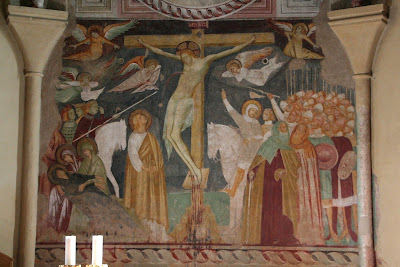
This has been a crazy week. I was in Dallas early in the week providing two workshops on the history and values of the RCIA (from the perspective of discipleship) and, after returning to Los Angeles late Wednesday evening, I led a mini-retreat celebrating Mercy on Thursday evening. I'm grateful that all three events went well and were each was a time of blessing. However, the Church's calendar keeps marching on and, so, I'm happy to share my reflections on this Sunday's Gospel. 14th century Crucifixion from the Abbey of Chiaravalle della Colomba in Alseno, Italy The Church's calendar continues to move forward, however, and I'm happy to share my reflections on this Sunday's Gospel. Jesus lived his life for others, offering everyone he encountered an opportunity for a new kind of relationship with God and with those around him. Everything in the life of Jesus—his friendships, his teachings, and his miracles—were signs of God’s unlimited mercy and c...

What More Is Required?: The Twenty-Eighth Sunday in Ordinary Time

Image
Below is the link to my reflection on this Sunday's Gospel and First Reading.  Jesus and the Rich Young Ruler by Heinrich Hoffman   Like Saint Francis and Blessed Teresa, the young man of today’s Gospel is faced with an opportunity and a choice. Already a righteous, faithful man, he seems to recognize that something more was being asked of him. Perhaps it was a sense that simply keeping the commandments wasn’t enough or he might have seen the joy in Jesus’ closest followers and wanted that for himself. Regardless of the reason, he approached Jesus and asked what more was required of him and Jesus clearly told him the cost of being a disciple: let go of everything that was holding him back from giving himself completely to God. We can understand the man’s frustration and confusion. Although he had always observed the commandments, “he went away sad, because he had many possessions.” Jesus was asking him to shift his focus from earthly possessions and concerns to the thin...

"You Are Not Like Us": The Twenty-Sixth Sunday in Ordinary Time

Image
Below is the link for my reflection on this Sunday's First Reading and Gospel in which I reflect on the Insider/Outsider perspective that is so prevalent in society and in the Church.  St. Anthony the Abbot Our disdain of those who do not think like “we” do—whomever “we” may be—reminds me of a teaching of the great Desert Father, Saint Anthony: “A time is coming when men will go mad, and when they see someone who is not mad, they will attack him saying, ‘You are mad—you are not like us.’” Rather than recognize and welcome diverse perspectives, experiences, and opinions, many of us dig in along the trenches of ideology, political rhetoric, or theological certainty, criticizing and excluding those who “do not follow us.” And whether it is in broader society or within the Church, many seem unwilling—even incapable—of creating spaces of hospitality and dialogue . To read the full reflection, click here .

Welcoming the Little Children: The Twenty-Fifth Sunday in Ordinary Time

Image
In my commentary for this Sunday, I reflect on what it means to welcome a little child as Jesus did. Jesus and the Little Child by Carl Bloch "There is no great theological discourse or political rhetoric here. In a single gesture, Jesus summarizes the beauty and the mystery of his message: even those whom the world sees as insignificant are important in God’s eyes. To be Jesus’ follower means that we have to be willing to embrace those dismissed by the world. True greatness comes from serving others." To read the full reflection, click here .

Taking Up the Cross: The Twenty-Fourth Sunday in Ordinary Time

Image
In the latest installment in my series of reflections on the Sunday Readings , I explore the meaning of the words "Take up your cross and follow me." By telling us to “take up” our cross, Jesus isn’t saying that we have to meekly endure unfair treatment and suffering or embrace a blind, “offer it up” sort of spirituality. And, while they may be opportunities for grace, illness, sad events, and even disasters aren’t “the cross.” There is nothing particularly Christian about many of the challenges we face in daily life. Finally, we can never silently or blindly accept abuse or injustice as being the will of God. Jesus rejected these and so should we. Instead, “the cross” that we are to carry is the sacrifices, trials, and hardships that can be a consequence of placing our faith and hope in him and of living according to his teaching. To read the full reflection, click here .

Saint Silas and the "We" of the Church

Image
Paul chose Silas and departed after being commended by the brothers to the Lord. He traveled through Syria and Cilicia bringing strength to the churches. — Acts 15:40-41 I didn’t always have the name “Silas.” In fact, for the first 25 years of my life, I wasn’t even aware that there was a saint by the name of Silas. The only Silases I knew of were George Elliot’s Silas Marner and Dan Brown’s menacing monk in the DaVinci Code . However, as I was preparing to make my first vows as a Benedictine monk in 2004, I was faced with the challenge of discerning three names to present to the abbot, one of which he would choose to be my religious name. I had settled on my first choice, but was completely undecided about choices two and three. A week or so before I had to present my selections, I came across the website of an Anglican parish in London: Saint Silas the Martyr. I was struck by two things. First, I’d never heard of Saint Silas and, second, I really liked the name. And so I...

Not Everyone Who Says, "Lord, Lord"...

Image
Today's Gospel passage is Matthew 7:21-29, which includes these words from Jesus: "Not everyone who says to me, 'Lord, Lord,' will enter the Kingdom of heaven, but only the one who does the will of my Father in heaven. Many will say to me on that day, 'Lord, Lord, did we not prophesy in your name? Did we not drive out demons in your name?' Then I will declare to them solemnly, 'I never knew you. Depart from me, you evildoers.'"   This is a passage that we need to pay very close ... attention to, particularly as so many Americans continue using faith as a weapon to justify so many crimes against one another and against creation.      A reflection on this text by Sr. Verna Holyhead, an Anglican Benedictine nun from Australia who died in 2011, has this to say: Today's Gospel is the conclusion of the Sermon on the Mount, and Jesus tells his listeners that having heard his words it now time to make choices. A lasting relationship w...

Listening to the Son

Image
This past week I began teaching a Lenten series at a local parish. While the 6-week program is ostensibly a study of the Ten Commandments, the series is really about how we—as believers—engage difficult moral issues. So, I suppose, it could be called “Moral Theology 101.” But, when all is said and done, the classes really come back to the basic theme of discipleship: how are we living out the faith we profess in our daily lives? We began our time together by reflecting on the importance of the season of Lent and how Lent is really a model for the Christian life because (when it is celebrated properly) Lent is always leading us somewhere—to the Cross and Empty Tomb. This is the season when we reflect on the quality of our discipleship and work on developing those virtues and habits that will enrich our faith and commitment so that, on Easter Sunday, we will be truer, holier disciples than we were on Ash Wednesday. Ideally, that forward momentum will continue through the Easter Se...

Saint Serenus the Gardener: Cultivating Virtue

Image
The one who supplies seed to the sower and bread for food will supply and multiply your seed and increase the harvest of your righteousness. —2 Corinthians 9:10 As we celebrate the Season of Lent—the Church’s “springtime”—it seems only fair that among the holy women and men we remember in these reflections is a saint who is honored as one of the patron saints of gardeners: Saint Serenus. Born to a Greek family in the third century, Serenus (who is widely known as Saint Cerneuf in France) became a hermit, living on produce he grew in his hermitage garden in Syrmium (Sremska Mitrovica in modern-day Croatia). When a persecution of Christians erupted, Serenus went into hiding for several months. He eventually returned to his hermitage and garden and it seems to have been widely known that he was a Christian. The most popular account of his life tells us that he was an exceptionally attractive man and a hard worker. He was respected and admired by everyone who came into contac...