Posts

Showing posts with the label Peter

The Fifth Sunday of Ordinary Time and a Lesson in Humility

Image
Getting into one of the boats, the one belonging to Simon, Jesus asked him to put out a short distance from the shore. Then he sat down and taught the crowds from the boat. After he had finished speaking, he said to Simon, “Put out into deep water and lower your nets for a catch.” Simon said in reply, “Master, we have worked hard all night and have caught nothing, but at your command I will lower the nets.” When they had done this, they caught a great number of fish and their nets were tearing. —Luke 5:3–6 This past week, as I was reflecting on this Sunday’s Gospel and thinking about what I would write in this reflection, I happened to have a conversation with another member of my religious community , during which he shared a question he recently asked the members of his parish in a daily homily: “How do you respond when someone confronts you about something you’ve done wrong?” It’s a good question. He shared three possible responses with his parishioners. “First,” he said, ...

Taking Up the Cross: The Twenty-Fourth Sunday in Ordinary Time

Image
In the latest installment in my series of reflections on the Sunday Readings , I explore the meaning of the words "Take up your cross and follow me." By telling us to “take up” our cross, Jesus isn’t saying that we have to meekly endure unfair treatment and suffering or embrace a blind, “offer it up” sort of spirituality. And, while they may be opportunities for grace, illness, sad events, and even disasters aren’t “the cross.” There is nothing particularly Christian about many of the challenges we face in daily life. Finally, we can never silently or blindly accept abuse or injustice as being the will of God. Jesus rejected these and so should we. Instead, “the cross” that we are to carry is the sacrifices, trials, and hardships that can be a consequence of placing our faith and hope in him and of living according to his teaching. To read the full reflection, click here .

Saint Silas and the "We" of the Church

Image
Paul chose Silas and departed after being commended by the brothers to the Lord. He traveled through Syria and Cilicia bringing strength to the churches. — Acts 15:40-41 I didn’t always have the name “Silas.” In fact, for the first 25 years of my life, I wasn’t even aware that there was a saint by the name of Silas. The only Silases I knew of were George Elliot’s Silas Marner and Dan Brown’s menacing monk in the DaVinci Code . However, as I was preparing to make my first vows as a Benedictine monk in 2004, I was faced with the challenge of discerning three names to present to the abbot, one of which he would choose to be my religious name. I had settled on my first choice, but was completely undecided about choices two and three. A week or so before I had to present my selections, I came across the website of an Anglican parish in London: Saint Silas the Martyr. I was struck by two things. First, I’d never heard of Saint Silas and, second, I really liked the name. And so I...

To Be a Witness

Image
In classes and days of recollection I offer during Lent, I often remind participants that the purpose of Lent is twofold: it is the time of final preparation of the uninitiated (i.e. catechumens) for baptism and the time for Christians to recall their own baptism and they prepare to renew their baptismal promises on Easter Sunday. Unfortunately, this second aspect of Lent often gets lost. Yes, we all renewed our baptismal promises at Easter and were symbolically sprinkled with holy water, but, for most of us, that moment seems to be over as soon as it has begun and we don’t really appreciate the significance of the act… which is surprising since we’ve spent 40 days preparing to say “I do!” with a renewed mind, heart, and spirit. We renew our baptismal promises each year because conversion and growing in faith are lifelong processes. In saying that, I simply mean that each moment of every day (not just the days of Lent) offers us infinite possibilities for experiencing grace, for cho...

Saint Cornelius the Centurion: The Light of Grace

Image
People will come from the east and west and from the north and the south and will recline at table in the Kingdom of God. For behold, some are last who will be first, and some are first who will be last. —Luke 13:20-30 What little we know about Saint Cornelius comes from chapters 10 and 11 of the Acts of the Apostles . However, his brief story marks an important shift in the life of the Early Church: through his encounter with Cornelius, Saint Peter was convinced that the Gospel message must be taken to the Gentiles. In Acts , Saint Luke tells us that Cornelius was the commander of a cohort of Roman soldiers and that he was “devout and God-fearing along with his whole household” (10:2). Luke continues by pointing out that Cornelius was generous in giving alms to the Jewish people and that he was a man devoted to God. These are important details, especially when we remember that the Jewish people were subjects of the Roman Empire. One afternoon, Cornelius received a...

Peter, Pius, and What We Leave Behind

Image
I generally have two books going at any given time—one for spiritual enrichment and the other for entertainment. I’m currently reading Jesus: The Son of Man by Kahlil Gibran and Love In the Time of Cholera by Gabriel Garcia Marquez. I’ve also been making my way through an audio version of Michael Cunningham’s The Snow Queen: A Novel. A few days ago, I was listening to The Snow Queen as I went for a walk and I was struck by this passage: There’s something about the courting of disaster, in shopping terms, that fascinates Barrett [one of the book’s main characters], that holds his attention, helps render him satisfied with his current stature. It’s the technically extinct but somehow still plausible hint of calamity implied by the impulse purchase—the impoverished dowager or disinherited young earl who says, “I’m going to walk the earth in this perfectly faded Freddy Mercury t-shirt (two-fifty), I’m going to party tonight in this vintage McQueen minidress (eight hundred), because...

Getting Out of the Boat

Image
During the fourth watch of the night, he came toward them, walking on the sea. When the disciples saw him walking on the sea they were terrified. “It is a ghost,” they said, and they cried out in fear. At once, Jesus spoke to them, “Take courage, it is I. do not be afraid.” Peter said to him in reply, “Lord, if it is you, command me to come to you on the water.” He said, “Come.” Peter got out of the boat and began to walk on the water toward Jesus. But when he saw how strong the wind was he became frightened; and beginning to sink, he cried out, “Lord, save me!” Immediately, Jesus stretched out his hand and caught him, and said to him, “O you of little faith, why did you doubt?” — Matthew 14:25-31   In one of my earliest (and most memorable) experiences of lectio divina (“holy reading”), I read Matthew’s account of Jesus walking on the water that we hear in this Sunday’s liturgy . This was nearly twelve years ago, shortly after I had entered monastic life. As I read...

Shots Heard 'Round the World

Image
There have been moments in the history of faith, which is at the heart of the human story, in which women, men, and even children, have made decisions about the course or orientation of their lives that have changed history itself. Like that “ shot heard ‘round the world ” of April 19, 1775, marking the first military action of the American Revolution, certain acts have opened up new pathways and modes of faith that have forever shaped the lives of countless believers through the ages.    The Calling of Saint Matthew by Caravaggio   Some of these might seem quite simple, perhaps because we know the stories so well: Mary’s fiat ( Luke 1:26-38 ), Saint Peter and Saint Andrew's decision to get out of their boat to follow the wandering Rabbi ( Matthew 4:18-20 ), and Saint Matthew leaving his tax collecting post (cf. Matthew 9:9-13 ). Others seem, somehow, far away and remote to us: Saint Lawrence presenting the poor, the Church’s true treasure, ...

An Apostlic Faith: Saints Peter and Paul

Image
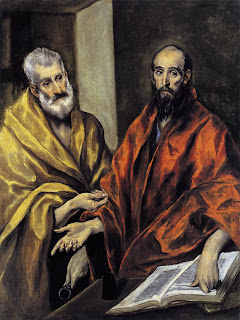
We celebrate this day made holy for us by the Apostles' blood. Let us embrace what they believed, their life, their labors, their sufferings, their preaching and their confession of faith. - Saint Augustine of Hippo    Saints Peter and Paul by El Greco   The great Apostles, Peter and Paul, so different in temperament and mission, have been honored with a common feast (June 29) since the first half of the fourth century. Peter, the first among the Apostles, and Paul, the Apostle to the Gentiles, were martyred in Rome, probably around the year 67, during the persecution of the emperor Nero.   The Collect for the Mass for this Solemnity reminds us that it was first through the preaching of Peter and Paul, and indeed all the Apostles, that the Church first received the Faith. This Apostolic Faith is manifested in our day in the celebration of the Church's sacraments, in the communion of prayer and faith in charity, and in the ministry of the Pope and the ...