Posts

Showing posts with the label Gospel

Saint Anselm of Canterbury

Image
Anselm was born of noble parents in Piedmont (Italy) around the year 1033. At the age of twenty-seven he entered the English Benedictine abbey of Bec, where he became abbot in 1078. As abbot, he gained renown for his preaching and reforming spirit. In 1093, he succeeded his former teacher, Blessed Lanfranc , as Archbishop of Canterbury. Anselm soon found himself at odds with King William Rufus, whose unjust policies compelled Anselm to leave England. After traveling to Cluny and Rome, the Anselm returned to England only after he had received word of the king’s death. Conflicts with the new king caused him to flee to Rome where Pope Paschal II defended Anselm’s claim to authority over the English church. In 1106, he returned to Canterbury, where he died on April 21, 1109. Known as a man of recollection and erudition, Anselm’s writings have had a profound impact on Catholic thought and he has been called the “Father of Scholasticism.” Especially remembered for his Prosologion , the ...

April 2: Saint Francis of Paola

Image
Francis was born around the year 1416, at Paola, a small city in Calabria.   Educated by the Franciscans, he lived as a solitary about a half mile from Paola. He was eventually joined by two companions, and he built three cells and a chapel, in which the local priest would say Mass for them. This is regarded as the foundation for the Order of Friars Minims . In 1454, Francis constructed the new community’s first monastery, and their Rule of Life was approved by Pope SixtusIV in 1474. Francis soon established monasteries in Germany, France, and Spain.   Following the example of his patron, Saint Francis of Assisi, Francis was never ordained a priest and he was credited with a number of miracles, even during his life. Although none of his own words have survived, we know that he was completely devoted to solitude and self-denial, and that he had a special devotion to the Passion of Christ and the Mother of God.   In 1506, he wrote a Rule for nuns and accepted lay peo...

Saint Apollonia and the Beginning of Lent

Image
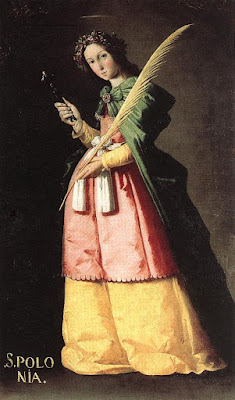
Saint Apollonia was an aged deaconess of the church of Alexandria. It is recorded that, as she was being beaten during an anti-Christian riot, all her teeth were knocked out. She was burned to death around the year 249.  Saint Apollonia by Francisco de Zurbarán Because of the suffering she endured, Saint Apollonia is honored as the patron of dentists and those with toothaches. In today’s Gospel , the scribes and Pharisees lash out at Jesus and his followers for not following the religious traditions that had been handed down by the elders. Jesus, however, reminds them that God isn’t interested in outward acts of piety. Instead, he reminds us that we must honor God in our hearts by loving and obeying God first. Our acts of devotion, if they are to be sincere, must then flow from that internal devotion and reverence. As we celebrate the memory of the martyr Apollonia today and prepare for Ash Wednesday and the Season of Lent, take time to reflect on your Lenten bona opera —“g...

Taking Up the Cross: The Twenty-Fourth Sunday in Ordinary Time

Image
In the latest installment in my series of reflections on the Sunday Readings , I explore the meaning of the words "Take up your cross and follow me." By telling us to “take up” our cross, Jesus isn’t saying that we have to meekly endure unfair treatment and suffering or embrace a blind, “offer it up” sort of spirituality. And, while they may be opportunities for grace, illness, sad events, and even disasters aren’t “the cross.” There is nothing particularly Christian about many of the challenges we face in daily life. Finally, we can never silently or blindly accept abuse or injustice as being the will of God. Jesus rejected these and so should we. Instead, “the cross” that we are to carry is the sacrifices, trials, and hardships that can be a consequence of placing our faith and hope in him and of living according to his teaching. To read the full reflection, click here .

Not Everyone Who Says, "Lord, Lord"...

Image
Today's Gospel passage is Matthew 7:21-29, which includes these words from Jesus: "Not everyone who says to me, 'Lord, Lord,' will enter the Kingdom of heaven, but only the one who does the will of my Father in heaven. Many will say to me on that day, 'Lord, Lord, did we not prophesy in your name? Did we not drive out demons in your name?' Then I will declare to them solemnly, 'I never knew you. Depart from me, you evildoers.'"   This is a passage that we need to pay very close ... attention to, particularly as so many Americans continue using faith as a weapon to justify so many crimes against one another and against creation.      A reflection on this text by Sr. Verna Holyhead, an Anglican Benedictine nun from Australia who died in 2011, has this to say: Today's Gospel is the conclusion of the Sermon on the Mount, and Jesus tells his listeners that having heard his words it now time to make choices. A lasting relationship w...

Saint Cornelius the Centurion: The Light of Grace

Image
People will come from the east and west and from the north and the south and will recline at table in the Kingdom of God. For behold, some are last who will be first, and some are first who will be last. —Luke 13:20-30 What little we know about Saint Cornelius comes from chapters 10 and 11 of the Acts of the Apostles . However, his brief story marks an important shift in the life of the Early Church: through his encounter with Cornelius, Saint Peter was convinced that the Gospel message must be taken to the Gentiles. In Acts , Saint Luke tells us that Cornelius was the commander of a cohort of Roman soldiers and that he was “devout and God-fearing along with his whole household” (10:2). Luke continues by pointing out that Cornelius was generous in giving alms to the Jewish people and that he was a man devoted to God. These are important details, especially when we remember that the Jewish people were subjects of the Roman Empire. One afternoon, Cornelius received a...

Christ the Teacher

Image
Each year the Scripture passages selected for the brief span of Ordinary Time that begins after the Feast of the Baptism of the Lord focus on the theme of discipleship. It's as if the Church is saying, "We've celebrated the Incarnation and everything has changed. Now, let's spend time really understanding Who it is that has come among us." And so, we heard stories about disciples being called, wonders and signs being performed, and accounts of healings and exorcisms, all aimed at helping us understand who Jesus really is. In the Gospel proclaimed on the Fourth Sunday of Ordinary Time, we hear Mark's very brief account of Jesus casting an unclean spirit out of a man. But if we really pay attention to the way the story is told, we see that the point isn't the exorcism, but more about Jesus the teacher and especially about the source of his authority. In his book, Fully Human, Fully Divine: An Interactive Christology Father Michael Casey, O.C.S.O., wri...

December 22 - Mary of Nazareth

Image
His mercy is from age to age to those who fear him. He has shown might with his arm, dispersed the arrogant of mind and heart. He has thrown down the rulers from their thrones but lifted up the lowly. - Luke 1:50-52 Our tradition has ascribed many titles to Mary. But I don’t believe there are many of us who would call the Mother of God a revolutionary. But in her Magnificat , which is re-told in today’s Gospel , we hear Mary speaking as a prophet: The One who has done great things in and for her is also changing the order of the world. The poor will be lifted up, the hungry will be fed, and the least of all the peoples will be glorified. There is no embrace of the status quo in her words. Instead, they celebrate the seismic shift that the Incarnation caused in hearts and in the world itself. John Howard Yoder , a Mennonite theologian, describes Mary’s words in this way: What it says is the language, not of sweet maidens, but of Maccabees: it speaks of dethroning the m...

Getting Out of the Boat

Image
During the fourth watch of the night, he came toward them, walking on the sea. When the disciples saw him walking on the sea they were terrified. “It is a ghost,” they said, and they cried out in fear. At once, Jesus spoke to them, “Take courage, it is I. do not be afraid.” Peter said to him in reply, “Lord, if it is you, command me to come to you on the water.” He said, “Come.” Peter got out of the boat and began to walk on the water toward Jesus. But when he saw how strong the wind was he became frightened; and beginning to sink, he cried out, “Lord, save me!” Immediately, Jesus stretched out his hand and caught him, and said to him, “O you of little faith, why did you doubt?” — Matthew 14:25-31   In one of my earliest (and most memorable) experiences of lectio divina (“holy reading”), I read Matthew’s account of Jesus walking on the water that we hear in this Sunday’s liturgy . This was nearly twelve years ago, shortly after I had entered monastic life. As I read...

God and Mammon: A Lesson in Stewardship

Image
There is a well-known phrase that is often used as a sort of “proof text” against the vice of greed: “You cannot love both God and money.” At the surface, God and money aren’t incompatible. In fact, Saint Augustine even encouraged people to provide for their eternal happiness by using the goods of the earth (cf. Discourses 359, 10). But the parable of the dishonest steward, from which this quotation is adapted, doesn’t use the word “money” (which does appear in certain popular translations of Scripture). Rather, the word used in the parable is “mammon,” a Phoenician term for economic security and success in business. Reflecting on mammon , Pope Emeritus Benedict XVI said, “we might say that riches are shown as the idol   to which everything is sacrificed in order to attain one’s own material success; hence, this economic success becomes a person’s true god.”   The Dishonest Steward from  Evangelicae Historiae Imagines (1594)   More than just making an ...

For the Feast of Saint Mark: The Evangelist's Offerings

Image
The man who is kindly, modest, merciful and just will not keep his good works to himself but will see to it that these admirable fountains send out their streams for the good of others. ~ Saint John Chrysostom  Saint Mark the Evangelist by Tzanes Emmanuel  in the Benaki Museum, Athens   The Acts of the Apostles and ancient tradition tell us about Saint Mark, who is often identified with John Mark, the companion of Paul and Barnabas. Originally a disciple of Saint Peter (cf. Acts 12:12 ), Mark became a collaborator of Saint Paul in his mission to the Gentiles, and he seems to have been with Paul during his imprisonment in Rome (cf. Colossians 4:10 ; 2 Timothy4:11 ). Eusebius of Caesarea , the famed Church historian, tells us that Mark spent the final years of his life serving as the bishop of Alexandria in Egypt.      Mark is most especially celebrated as the author of the Gospel that bears his name. While he himself was not an eyewitn...