Posts

Saint Turibius of Mongrovejo
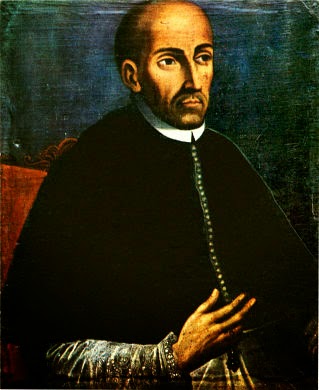
Image
Over the past several days I've been preparing for a webinar that I'll be giving for Paulist Evangelization Ministries on March 25 on the theme of discipleship. (As a side note, it's a free event and all are welcome to take part, so please consider "attending.") As part of my preparation, I've been re-reading sections of The Joy of the Gospel and some of Pope Francis' other writings and speeches. But, I've also been thinking about holy women and men whom I can use as examples of committed discipleship within the presentation. Although he didn't "make the cut," I couldn't help but give some thought to the saint the Church honors on March 23: Turibius of Mongrovejo. Saint Turibius was born in Spain in 1538. After teaching law at the University of Salamanca, he was appointed bishop of Lima, Peru, in 1580. A zealous pastor, he ministered to the people of Peru for the next twenty-five years. He traveled through the 18,000 square m...

The Witness of "Sister Cider"

Image
Charm is deceptive and beauty fleeting; The woman who fears the Lord is to be praised. Acclaim her for the work of her hands, And let her deeds praise her at the city gates. —Proverbs 31:30-31 We often fall into the trap of thinking that living the Gospel means doing extraordinary things. Certainly the experiences of so many of our brothers and sisters in the Middle East and Africa—who are witnessing to their faith in heroic ways—remind us that any one of us could be called upon at any moment to give our life for Christ, but, for most of us, our life of discipleship will be lived out in small, daily sacrifices and times of prayer. I think that one of the great tragedies of our faith tradition is that much of the beauty of the lives of the Saints has been lost within a haze of miracles and martyrdoms. But, like each of us, these women, men, and children lived ordinary lives. What set them apart wasn’t that the majority of their actions or prayers were extraordinary—w...

Oh, Patrick...

Image
March 17 is one of the days on the calendar that has always been lost on me. Whether we're thinking of Saint Patrick or "St. Paddy's Day," this great celebration of Ireland and Irish heritage has never really resonated with me... I suppose, the starting point would be a consideration of who the real Patrick was: Patrick was born about the year 389 in Britain. At age sixteen he was kidnapped and taken as a captive into Ireland where he served as a herdsman. Despite the harshness of this life, Patrick retained his Christian faith and used his solitude as an opportunity for prayer and meditation. After six years Patrick escaped captivity and returned to England. In a dream, however, he was urged to return and evangelize the people of Ireland. In preparation for his work, Patrick studied at the monastery at Lérins. He was ordained by Saint Amator in 417.          In 431, Patrick was sent to assist Saint Palladius in Ireland, and he was eventu...

Listening to the Son

Image
This past week I began teaching a Lenten series at a local parish. While the 6-week program is ostensibly a study of the Ten Commandments, the series is really about how we—as believers—engage difficult moral issues. So, I suppose, it could be called “Moral Theology 101.” But, when all is said and done, the classes really come back to the basic theme of discipleship: how are we living out the faith we profess in our daily lives? We began our time together by reflecting on the importance of the season of Lent and how Lent is really a model for the Christian life because (when it is celebrated properly) Lent is always leading us somewhere—to the Cross and Empty Tomb. This is the season when we reflect on the quality of our discipleship and work on developing those virtues and habits that will enrich our faith and commitment so that, on Easter Sunday, we will be truer, holier disciples than we were on Ash Wednesday. Ideally, that forward momentum will continue through the Easter Se...

Saint Serenus the Gardener: Cultivating Virtue

Image
The one who supplies seed to the sower and bread for food will supply and multiply your seed and increase the harvest of your righteousness. —2 Corinthians 9:10 As we celebrate the Season of Lent—the Church’s “springtime”—it seems only fair that among the holy women and men we remember in these reflections is a saint who is honored as one of the patron saints of gardeners: Saint Serenus. Born to a Greek family in the third century, Serenus (who is widely known as Saint Cerneuf in France) became a hermit, living on produce he grew in his hermitage garden in Syrmium (Sremska Mitrovica in modern-day Croatia). When a persecution of Christians erupted, Serenus went into hiding for several months. He eventually returned to his hermitage and garden and it seems to have been widely known that he was a Christian. The most popular account of his life tells us that he was an exceptionally attractive man and a hard worker. He was respected and admired by everyone who came into contac...

Keeping Lent Real

Image
In his Rule , Saint Benedict observes that "the life of a monk ought to a continuous Lent" (from chapter 49 ). Those words might strike some as harsh, but why is that? Is it because we too quickly associate Lent with ash-smudged foreheads, "giving up" things we generally enjoy, fishy Fridays, and lots talk about guilt and sin? The insight that we can gain from Saint Benedict's perspective is that the spirit of Lent is something that should permeate our lives every day of the year. And, by saying that, I don't mean the doom-and-gloom that too many associate with this season. Instead, Saint Benedict was saying that our Lenten emphasis on ongoing conversion and covenant is something we should carry with us each day, because conversion and covenant are at the heart of our commitment to follow Christ. This can only make sense for us today if we try to remember that Lent was originally a 3-day time of fasting and prayer for those who would be baptized at East...

The Seven Holy Founders, Lent, and Living for Others

Image
The Spirit comes to the aid of our weaknesses; For we do not know how to pray as we ought, But the Spirit himself intercedes with inexpressive groanings. —Romans 8:26 After the excitement of Valentine’s Day and celebrations of Carnival , the sobriety of Ash Wednesday can be quite a jolting beginning to our Lenten prayer and good works. Unfortunately, many of us miss out on irreplaceable opportunities for growth and enrichment because we focus too much of our attention on the “thou shalt nots” of Lent and overlook the fact that Lent is really intended to be a spiritual springtime. By thinking only of Lenten penances, we fail to see how our self-denial should be balanced with good works of prayer and charity. As we make our final preparations for Ash Wednesday and the season of Lent, the Seven Founders of the Servite Order (who are honored with a common commemoration on February 17) offer a fitting example of what our prayer, charity, and conversion might be as we celebr...